Peter Honorious
The Robot Who Looked Like MePeter Honorious is a prosperous young executive caught between a state-mandated marriage deadline and the impossibility of knowing in advance whether a match will work. His attempt to preview married life turns bureaucratic matchmaking into a personal gamble: a computer can project five years with a prospective wife, but the decisive encounter with Dinah Grebs leaves the future open.
Identity and Circumstances
On a bright September morning, Honorious receives a peremptory directive from his local Consanguinity Board: he must marry by October 1 or face contempt proceedings under the State and Federal Pair-Bonding Regulations, with penalties that could include one to five years at Lunaville. The order catches him off guard. He had filed an Extension of Current Status form in August and expected it to give him another six months to choose a wife. Instead, he has barely two weeks to comply or flee to Mexico, an option he considers undesirable in 2038.
Honorious does not oppose marriage or the social order behind the regulations. At lunch with Earl Ungerfjord, his oldest friend, he calls the demand unfair and wonders why anyone would persecute him when he is no rebel. He accepts the premise that marriage is the minimum social transaction and the foundation of the State’s security; he says he wants to marry, but has not found the right person. Ungerfjord, married for almost a month, suggests that Honorious may be too fussy. Honorious answers that he would currently settle for almost anything short of disaster, because profiles and matching methods cannot show whether a couple will succeed until they have tried the relationship—and by then, it may be too late to undo the choice.
Seeking a Preview
Honorious turns to Euler, who offers access to a captive terminal outlet despite the difficulty of getting near the Simulator. Honorious accepts readily. The arrangement gives him ten minutes of computer time two days later, with Miss Grebs to guide him through the procedure; he is told to bring data cards for himself and his prospective wives.
He arrives with cards for fifteen candidates selected by Computerized Marriage Matchup Services. The Madison Avenue agency has chosen them from the National Availability Pool of American Single Women using answers to 1,006 questions. The women are known to him only by numbers until an Official Pair-Bonding Decision, and all have elected instant-available status: his agreement to marry one would be enough to settle the match. The system makes each prospective marriage legible as data while withholding the candidates’ names and ordinary identities.
The terminal itself is concealed in a furniture van at the back of a used-car lot on DeKalb Avenue. Two technicians disguised as derelicts lead Honorious into a blacked-out inner room, seat him at the humming machine, and fasten psychometallic electrodes to his forehead and wrists. The secrecy and improvised setting contrast with the State’s formal demand that he marry: the sanctioned system has made his deadline urgent, while the preview he seeks depends on concealed equipment and access.
The Forecasts and Candidate 6903
The simulated marriages do not reassure him. The remembered outcomes include a shy woman whose long silences first make his Easthampton twilights seem romantic, then leave him yelling at her to speak; another candidate turns out to have a talent for roller derby; and a suicidal prospective wife never gets around to killing herself. One remembered match begins with a woman handing out Scientology leaflets in Trafalgar Square after five years together. The forecasts reduce a marriage to a sequence of scenes, but their variety gives Honorious no reliable way to select a safe future.
By September 29, after viewing fourteen possible marriages, he is alarmed and despondent. He goes to his final appointment almost resigned to choosing number eleven, the Giggler with the Two Stupid Brothers, whom he considers at least not totally disastrous. For security reasons, the terminal has been moved from DeKalb Avenue to a washroom down the hall from Euler’s office. There, Honorious plugs in and sees a five-year life with candidate 6903.
The forecast moves through distinct places and domestic moments: a walk on a beach at Martha’s Vineyard, a crossing of the George Washington Bridge, goat’s cheese and wine on a limestone outcrop above the Aegean, and a rocky plain beneath distant, white-capped mountains that he cannot identify with certainty. In Miami, the woman wears his raincoat as they run laughing in the rain. The vision ends in a low white house, where they are very much in love and Honorious walks up and down with their colicky baby. Unlike the earlier previews, this sequence gives him a future he wants rather than a catalogue of reasons to avoid a match.
Encounter with Dinah Grebs
Honorious goes straight to Euler’s office and announces that he has found the woman he may love. He is ready to make the Pair-Bond Agreement immediately and asks for the Public Records Machine, still knowing candidate 6903 only as a number. His enthusiasm marks a reversal from the man who had entered the appointment prepared to settle for the least disastrous option.
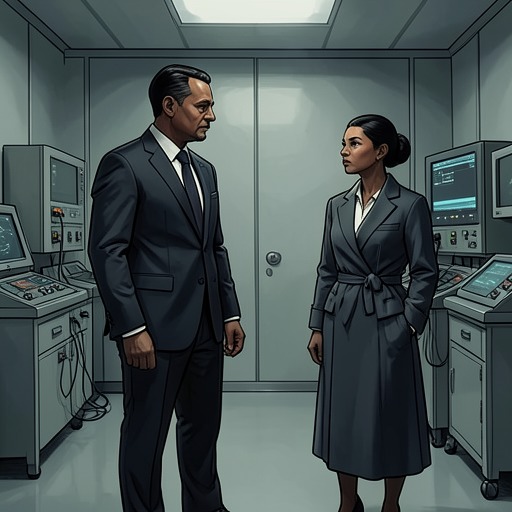
The movement from projected intimacy to actual contact is not a simple confirmation of the forecast. In the encounter with Grebs, Honorious curses and moves toward her; she swings at him, he seizes her wrist, and they end up in close physical contact, breathing hard and looking at each other. The narrative identifies love as the unofficial force within pair-bonding that cannot be predicted: it overrides directives and previous obligations even as the State depends on mating machinery for its stability. The computer can stage a possible shared life, but it cannot produce or guarantee the feeling that makes that life meaningful.
Later, Honorious asks Dinah whether their future was real or whether she altered her own data. She tells him he will have to wait and find out. Her answer leaves the forecast’s truth unresolved: the projected marriage and baby may describe what awaits them, but Honorious cannot verify that future in advance. His arc thus ends not with a confirmed Pair-Bond Agreement or a settled domestic outcome, but with the very uncertainty he had hoped technology could remove. The preview has brought him to Grebs; it cannot tell him what their relationship will become.